
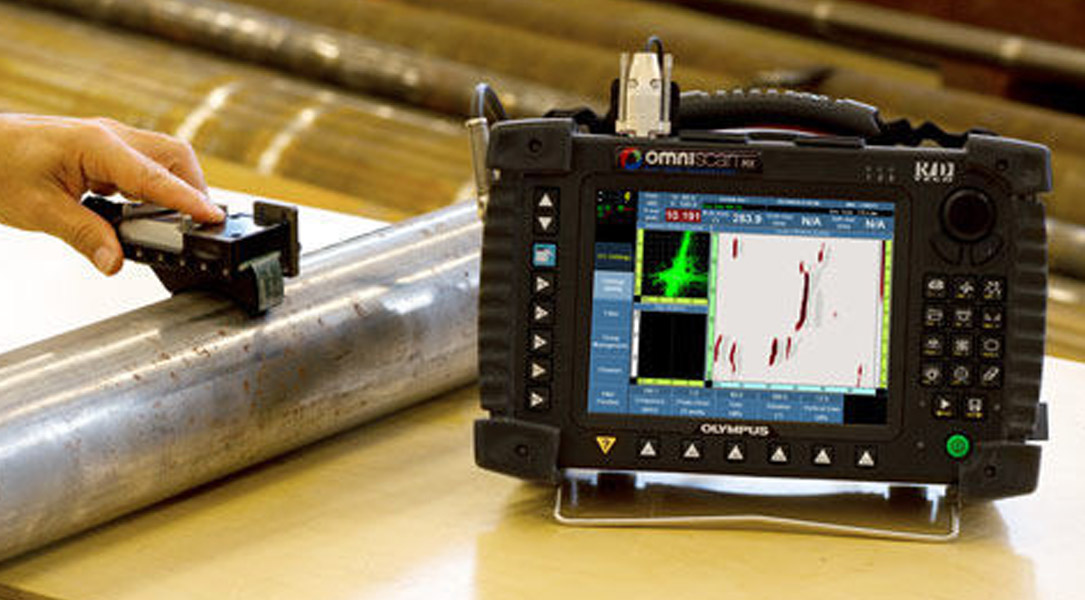
If you already have some experience with conventional form of UT, then you may know that PAUT is something that technicians often talk about when discussing their work. This is because PAUT is one of the most popular forms of advanced NDT. But what exactly is PAUT? Who can learn it?
Course Overview and Career Prospects
This course overview gives answers to both these questions and guides you through understanding whether taking a PAUT Level II Course will be the correct move for your NDT career.
At IIT NDT, practical PAUT Training programs in Kochi and Chengannur give you an opportunity to understand the theory of phased array technology and learn how to use PAUT instruments
What Is PAUT?
PAUT stands for Phased Array Ultrasonic Testing. This is an advanced version of Ultrasonic Testing, which is done with the purpose of detecting cracks, lack of fusion, lack of penetration, corrosion and other discontinuities, without compromising the inspected part.
Unlike conventional UT, where the inspector normally operates with one-element probe, phased array probe consists of many small ultrasonic elements, which are controlled electronically in order to change the direction and focusing of the sound beam at various angles and depths.
Simply put, PAUT helps the inspector inspect the part from a larger area and at different angles while gathering the inspection information digitally. The information gathered using this equipment can be presented in the following ways: A-scan, B-scan, C-scan and S-scan.
PAUT is commonly used for:
- Weld inspection
- Pipeline inspection
- Pressure vessel examination
- Corrosion mapping
- Crack detection
- Thickness assessment
- Inspection of complex components
- In-service industrial inspection
Companies providing a professional PAUT service often use this technology when a project requires faster scanning, recorded data and detailed defect evaluation.
Why Should You Learn PAUT?
The traditional method of Ultrasonic Testing is still used for industry inspections. But today, advanced digital inspections are utilized for most large-scale projects because of the better coverage and consistency of their results.
Learning PAUT can help an NDT technician move beyond basic equipment operation and develop more advanced skills in inspection planning and data interpretation.
During a PAUT Level II Course, you can learn how to:
- Select the correct probe and wedge
- Create and understand focal laws
- Set inspection parameters
- Calibrate PAUT equipment
- Develop a basic scan plan
- Perform manual and encoded scanning
- Read sectorial scan images
- Locate and evaluate indications
- Record inspection findings
- Prepare a professional inspection report
PAUT Training may come across as an obvious choice for a UT technician with years of experience. It can also help mechanical engineers, Quality Assurance/Quality Control personnel and welders interested in entering the Advanced NDT training program.
Who Can Join a PAUT Level II Course?
PAUT courses attract learners from different educational and professional backgrounds. Common candidates include:
- ITI holders from relevant technical trades
- Diploma holders in Mechanical, Production or Automobile Engineering
- BTech or BE graduates in Mechanical or Metallurgical Engineering
- NDT technicians with conventional UT experience
- Mechanical QA/QC professionals
- Welding inspectors
- Professionals working in fabrication, pipelines or oil and gas projects
However, eligibility is not exactly the same for every programme. It may depend on the certification scheme, the employer’s written practice, previous training and documented industrial experience.
Before joining, ask the institute to clearly explain the eligibility requirements and the type of training, examination or certification being offered.
Do You Need Conventional UT Knowledge Before Learning PAUT?
A good understanding of conventional Ultrasonic Testing is strongly recommended before starting PAUT. PAUT is based on the same core ultrasonic principles, so it will be easier to understand if you are already familiar with:
- Ultrasonic wave behaviour
- Sound velocity and wavelength
- Reflection and refraction
- Probe selection
- Equipment calibration
- Weld geometry
- Common welding defects
- A-scan interpretation
Some people take up an NDT Level 2 class prior to joining PAUT. The necessity for UT Level II certification depends on which route you choose to follow. In case you are thinking about an ASNT Level 2 class, you should find out the precise requirements for entry.
What Do You Learn in a PAUT Level II Class?
A decent PAUT program should not be focused on theory alone. It should teach you to use the equipment, calibrate it, scan samples, analyze the data and record your findings. The syllabus generally covers the following areas.
Ultrasonic Testing Fundamentals
The course normally starts with a review of the UT fundamentals. The subjects could include ultrasonic wave propagation, types of waves, acoustic impedance, reflection, refraction, attenuation, near-field zone, probe characteristics, and typical discontinuities in welds.
It is critical since PAUT is based on the UT fundamentals.
Phased Array Principles
Students are introduced to the construction and operation of a phased array probe. They learn how multiple probe elements work together and how electronic time delays are used to control the ultrasonic beam.
Topics may include:
- Beam steering
- Beam focusing
- Aperture selection
- Active probe elements
- Linear scanning
- Sectorial scanning
- Focal law generation
These concepts may initially sound complicated, but they become easier to understand when combined with live equipment demonstrations.
PAUT Equipment and Accessories
Candidates learn about the equipment and accessories used during an inspection, including:
- PAUT instruments
- Array probes
- Wedges and scanners
- Encoders
- Calibration blocks
- Couplants
- Data acquisition software
Students should also learn how to create inspection files, adjust equipment settings, save data and retrieve previous scan results.
Probe and Wedge Selection
Not every probe or wedge is suitable for every inspection. The correct selection depends on factors such as the material, thickness, weld configuration, required coverage and applicable inspection procedure.
Training normally explains how probe frequency, number of elements, wedge angle and focal depth affect the inspection result.
Equipment Calibration
Calibration is one of the most important practical skills in PAUT. If the equipment is not calibrated correctly, the collected data may be unreliable.
Practical exercises may cover:
- Velocity calibration
- Wedge-delay calibration
- Sensitivity calibration
- Encoder calibration
- Time-corrected gain
- Angle-corrected gain
- Reference sensitivity
- Calibration verification
Students should have enough supervised practice to understand why each calibration step is required.
Scan Plan Preparation
Before scanning a weld, the technician needs to decide how the required area will be covered. This is done through a scan plan.
While preparing a scan plan, the inspector considers the weld geometry, material thickness, probe position, beam angles, focal depth, index offset and possible inspection limitations.
A well-prepared scan plan helps ensure that the required weld volume is properly examined.
Data Acquisition and Interpretation
PAUT equipment produces more detailed digital data than conventional manual UT. Students therefore need practical experience reading different display formats, including:
- A-scan
- B-scan
- C-scan
- S-scan or sectorial scan
- Linear scan
Candidates also learn how to adjust the display, collect encoded or manual scan data, save inspection files and review recorded results.
Defect Detection and Evaluation
One of the most interesting parts of PAUT Training is learning to identify indications in the scan data. Students may practise detecting and evaluating:
- Lack of fusion
- Incomplete penetration
- Cracks
- Slag inclusions
- Porosity
- Undercut
- Lamination
- Corrosion or wall loss
They must also learn to separate actual defect indications from weld geometry and other non-relevant signals. This ability develops through repeated practice and guidance from an experienced trainer.
Codes, Procedures and Reporting
Industrial inspections must follow approved procedures and applicable acceptance criteria. Therefore, a PAUT Level II Course should also introduce students to equipment verification, inspection procedures, relevant codes, traceability and client requirements.
Candidates should learn how to prepare a report containing details such as:
- Component and weld identification
- Equipment, probe and wedge details
- Calibration information
- Scan plan
- Location and dimensions of indications
- Evaluation results
- Inspection limitations
- Relevant scan images
Technical knowledge is important, but clear documentation is equally valuable in an actual project environment.
Why Practical PAUT Training Matters
PAUT cannot be learned properly through theory alone. A student may understand beam steering or focal laws in a classroom but still find it difficult to configure the equipment or interpret a real scan.
Practical-oriented training should allow students to:
- Connect and configure the equipment
- Select suitable probes and wedges
- Create focal laws
- Perform calibration
- Prepare scan plans
- Scan weld samples
- Acquire and save data
- Identify relevant indications
- Evaluate the location of defects
- Prepare inspection reports
The IIT NDT Kochi PAUT program is primarily geared towards practical training of operating equipment, calibrating equipment, capturing data, imaging, analyzing defects and reporting.
Before selecting any course, ask how much individual equipment practice is included. This is more important than simply checking the total number of classroom days.
PAUT vs Conventional UT vs TOFD
Students frequently inquire on which between PAUT and UT or TOFD techniques is superior. However, each of the three approaches possesses distinct advantages, depending on the type of examination required.
| Method | Conventional UT | PAUT | TOFD |
|---|---|---|---|
| How it works | Usually uses a single-element probe with manual positioning | Uses multiple elements to steer and focus ultrasonic beams electronically | Uses diffracted signals from the tips of a discontinuity |
| Common applications | Thickness measurement and manual weld inspection | Weld inspection, imaging and corrosion mapping | Weld examination and through-wall sizing |
PAUT offers detailed imaging and inspection from multiple angles. TOFD is particularly useful for detecting and sizing certain weld discontinuities. On many projects, the two methods are used together rather than as replacements for each other.
It is worth mentioning that PAUT trained candidates may also opt for TOFD training. This is because inspection companies will give the PAUT service and the TOFD service in case the project needs thorough weld testing.
Where Is PAUT Used?
PAUT is used in industries where the condition of welds and critical components must be checked without cutting or damaging them. These industries include:
- Oil and gas
- Refineries and petrochemical plants
- Pipeline construction
- Pressure vessel manufacturing
- Power generation
- Structural fabrication
- Shipbuilding
- Offshore projects
- Aerospace manufacturing
- Railway and transportation
- Heavy engineering
The method is valuable for both manufacturing inspections and the examination of components that are already in service.
Career Opportunities After PAUT Level II Training
PAUT skills can support career development in India and overseas, especially when combined with conventional NDT knowledge, documented experience and the appropriate certification.
Depending on their qualifications and experience, candidates may work towards roles such as:
- PAUT Technician
- Advanced NDT Technician
- Ultrasonic Testing Technician
- NDT Inspector
- Weld Inspection Technician
- PAUT Data Analyst
- Pipeline Inspection Technician
- QA/QC Inspector
- Inspection Engineer
- NDT Site Coordinator
Completing a training course does not automatically make a person eligible to carry out unsupervised industrial inspections. Employers will normally consider the candidate’s education, training hours, practical ability, experience and certification status.
Under an SNT-TC-1A employer-based programme, personnel are certified according to the employer’s written practice. Students should therefore ask whether a course provides training, examination support, employer-based qualification or an independent personnel certification pathway.
Other Training Options for an Inspection Career
PAUT is one part of the wider NDT and quality inspection field. Once you understand your preferred industry and job role, you can select additional courses that complement your PAUT skills.
Relevant options may include:
- TOFD Training for advanced ultrasonic weld examination
- ISO 9712 training for a third-party personnel certification pathway
- PWHT training for post-weld heat treatment knowledge
- Welder Qualification and WPS qualification
- Painting Inspector Course for protective coating inspection
- RIG inspection training for drilling-related inspection knowledge
- Safety Course for industrial safety awareness
- Mechanical QA QC course in Kerala
- Mechanical QA QC course in Kochi
- Oil and gas course in Kerala
Professionals working with companies that provide Advanced NDT services, general Inspection services or Lifting equipment inspection may benefit from developing skills across more than one inspection area.
How to Choose the Right PAUT Training Institute
Students comparing NDT course fees in Kerala should request a complete fee breakdown. Check whether equipment practice, study materials, examinations and certification-related charges are included.
Similarly, if you are searching for an NDT course with placement in Kochi, ask whether the institute provides placement assistance, interview preparation or employer connections. Placement assistance should not be confused with a guaranteed job.
PAUT Training at IIT NDT Kochi and Chengannur
IIT NDT offers conventional and Advanced NDT training for students and working professionals. Candidates looking for an NDT course in Kerala, an NDT course in Kochi or practical training in Chengannur can enquire about its upcoming PAUT batches.
As an NDT training institute in Kerala, IIT NDT focuses on helping candidates develop skills that are relevant to industrial inspection work.
The PAUT training programme covers areas such as:
- PAUT principles and instrumentation
- Probe and wedge selection
- Equipment setup and calibration
- Scan planning
- Data acquisition and imaging
- Defect detection and evaluation
- Inspection reporting
- Practical scanning exercises
Students searching for an NDT training institute in Kochi can contact IIT NDT to confirm the latest eligibility requirements, training dates, course duration and fees.
Take the Next Step in Your NDT Career
A PAUT Level II Course can be a valuable choice for UT technicians, mechanical graduates and QA/QC professionals who want to move into advanced inspection work.
The right training should give you more than theoretical knowledge. It should help you understand the equipment, practise calibration, scan actual samples, interpret data and prepare professional reports.
IIT NDT offers practical-oriented Advanced NDT training in Kochi for candidates who want to strengthen their technical knowledge and explore career opportunities in industrial inspection.
Contact IIT NDT for information about PAUT Training, eligibility, upcoming batches and course fees.
Frequently Asked Questions
1. Who can join a PAUT Level II Course?
ITI holders, diploma students, engineering graduates, QA/QC professionals and working NDT technicians may be eligible to join. Previous knowledge of conventional Ultrasonic Testing is strongly recommended. Exact eligibility will depend on the programme and applicable certification requirements.
2. Do I need UT Level II before learning PAUT?
A conventional UT background is highly beneficial because PAUT builds on ultrasonic principles, calibration, probe behaviour and defect interpretation. Whether a UT Level II qualification is compulsory depends on the certification scheme, employer requirements and course structure.
3. Is PAUT difficult to learn?
PAUT may seem complex at first because it involves focal laws, multiple beam angles and digital scan images. However, students with a good UT foundation can understand it through clear instruction and regular practical exercises. Sufficient equipment practice is essential.
4. Does completing PAUT training make me ASNT Level II certified?
Not automatically. Training, examination and certification are different stages. Under an SNT-TC-1A employer-based system, the employer certifies personnel according to its written practice. Candidates should ask the institute to clearly explain the exact training or credential being offered.
5. What jobs can I apply for after PAUT Level II training?
Depending on your education, experience and certification status, you may work towards roles such as PAUT Technician, Advanced NDT Technician, NDT Inspector, Weld Inspection Technician or PAUT Data Analyst. Opportunities are available in oil and gas, fabrication, petrochemical, pipeline, power, shipbuilding and offshore sectors.